

In the current landscape of investment watches, few comparisons generate as much sustained attention as Omega versus Rolex. Both brands operate within the upper tier of Swiss horology, both command global recognition, and both maintain active secondary markets within the broader ecosystem of leading Swiss watch brands. Yet when evaluated through the lens of value retention and liquidity, the distinctions become more structural than stylistic.
Over the past decade, pricing transparency and digital resale platforms have reshaped how collectors assess long-term positioning. Rolex has historically demonstrated stronger resale consistency, while Omega has invested heavily in technical innovation and brand reinforcement. As market cycles normalize, the relevant question is no longer about popularity, but durability. For capital-conscious collectors, institutional behavior across time provides a clearer framework than short-term sentiment.
Two Institutional Models, Not Just Two Brands
This is not a comparison of aesthetics — it is a comparison of value governance models Longines Flagship Men’s Watch.
The Omega versus Rolex debate is often framed emotionally — heritage, aesthetics, brand loyalty. For disciplined collectors, however, the distinction lies in institutional structure.
Rolex operates as a controlled liquidity engine. Production is scaled, but distribution remains strategically restricted. Incremental design continuity reinforces familiarity. Allocation discipline maintains persistent demand imbalance.
Omega operates as a technical innovation institution with broader distribution logic. Engineering differentiation, certification standards, and material experimentation reinforce mechanical credibility rather than scarcity dynamics — a structural distinction also visible across investment watches that hold value.
Structural Positioning: Scarcity and Distribution Logic

Rolex — The Scarcity-Regulated System
Rolex has built its position on three reinforcing pillars: production discipline, incremental design continuity, and allocation control. Core families such as the Submariner, Daytona, and Datejust function less as product lines and more as liquidity channels.
Scarcity is embedded structurally. Waiting lists and restricted retail allocation create sustained secondary demand concentration. Familiarity becomes a stabilizing force rather than a constraint.
Omega — The Engineering-Led Portfolio Model
Omega’s institutional structure differs in emphasis. The brand operates across a diversified architecture: professional tool watches, dress references, experimental materials, and Master Chronometer-certified movements.
Where Rolex optimizes scarcity, Omega optimizes mechanical legitimacy. Co-Axial escapements, METAS certification, and anti-magnetic standards build reputational capital. The tradeoff is broader availability and more diffused resale concentration.
Comparative Structural Matrix
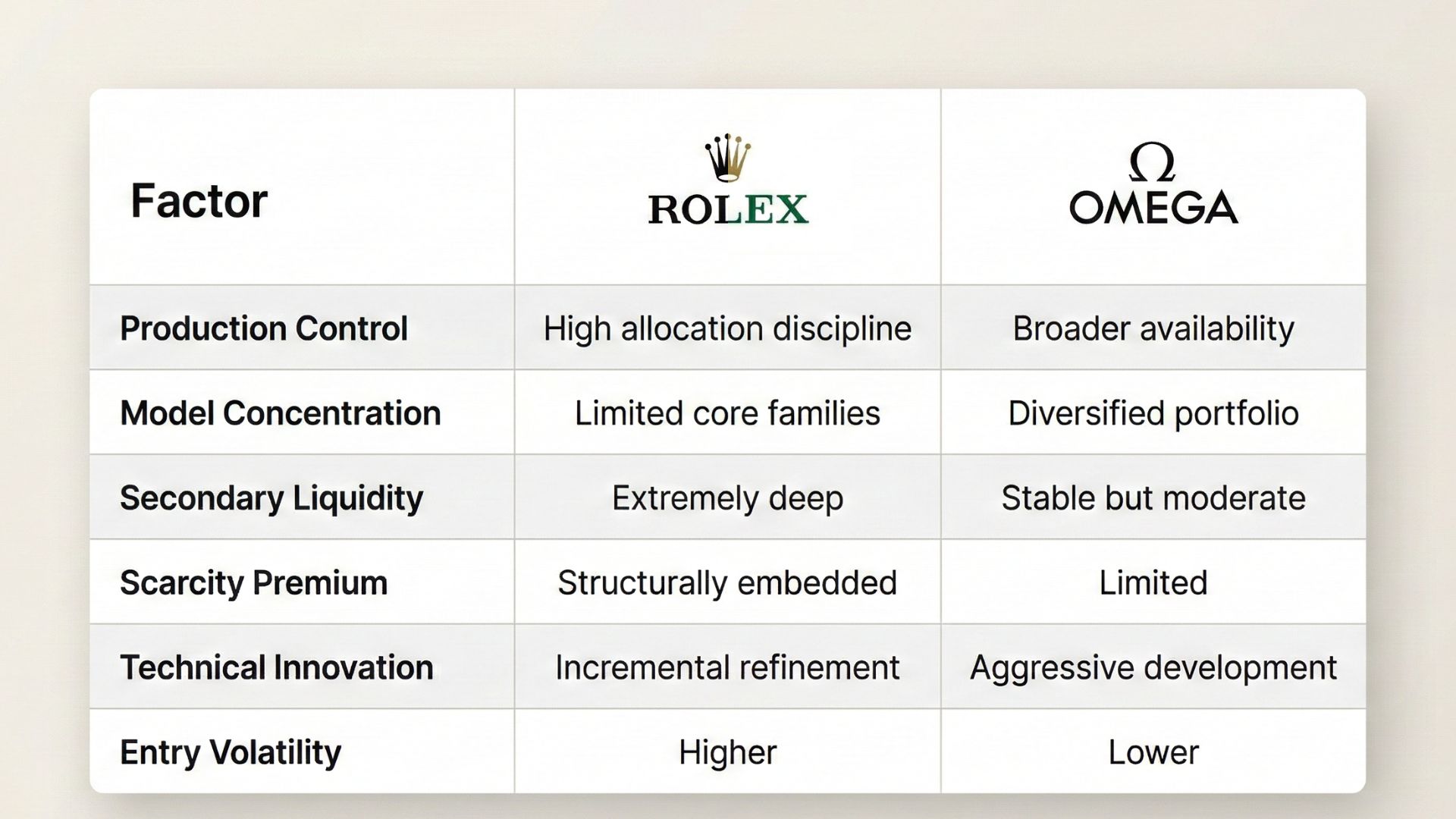
The divergence is not about superiority. It is about system design.
Liquidity Behavior Across Market Cycles
Expansion Phases
During expansionary luxury cycles, Rolex sports references frequently detach above retail, trading velocity accelerates, and grey-market spreads widen. Rolex behaves like a high-demand asset with constrained float.
Omega references may appreciate, yet rarely detach from retail at systemic scale. The brand behaves more like a fundamentally stable luxury instrument than a scarcity-amplified asset.
Correction Phases
During contraction periods, liquidity concentrates around core Rolex references. Secondary spreads compress but trading remains active. Hype-driven references normalize sharply.
Omega typically experiences smoother normalization due to wider availability and lower speculative inflation. Rolex absorbs volatility through demand concentration; Omega absorbs volatility through pricing accessibility.
Long-Term Horizon: Structural Retention Patterns
Over extended holding periods, core Rolex models demonstrate stronger percentage retention and deeper cross-market liquidity. Generational brand reinforcement strengthens institutional continuity.

Omega maintains respectable stability, supported by technical credibility and cultural milestones. References such as the Speedmaster Professional derive resale resilience from historical legitimacy rather than engineered scarcity.
The divergence is not about superiority. It reflects system design. Rolex functions as a liquidity anchor. Omega functions as a technically respected blue-chip with broader entry stability.
Reference-Level Behavior Matters
Institutional strength does not eliminate selection risk. Not all Rolex references outperform. Not all Omega references underperform. Entry price discipline and reference specificity determine realized outcomes.
- Liquidity is reference-specific, not brand-uniform.
- Market cycles compress irrational spreads.
- Core families outperform peripheral releases.
- Scarcity premiums fluctuate with sentiment.
Collectors who evaluate brands at headline level often misread capital dynamics. Institutional architecture influences outcomes, but reference selection defines results.
Allocation Logic: Complementary Roles
Within diversified luxury portfolios, Rolex often serves as the liquidity stabilizer. Omega functions as the engineering-weighted complement. They are not substitutes; they are structurally distinct tools frequently considered within curated collector allocations.
Buyers prioritizing resale optionality and liquidity dominance often align with Rolex’s allocation model. Buyers prioritizing mechanical depth and long-term ownership stability often align with Omega’s distributed engineering framework.
Brand loyalty is emotional. Capital behavior is structural.

Final Assessment
Measured strictly through resale velocity and short- to mid-term liquidity resilience, Rolex demonstrates stronger structural consistency. Measured through technical credibility, pricing balance, and ownership stability, Omega offers disciplined long-term positioning without reliance on scarcity engineering.
The decision is not about superiority. It is about institutional alignment. For capital-aware collectors, understanding how each structure behaves across cycles is more relevant than brand rivalry.
At Diamond2Partners, evaluation remains analytical and curated — focused on disciplined acquisition pathways across authorized channels and vetted secondary platforms. The distinction between collecting and allocating lies in recognizing how institutional design shapes capital outcomes.


